Essential Road Bike Fit Measurements
Triathlete and founder of BikeFittr
Reduce guesswork
Want the answer for your own bike?
Use this essential road bike fit measurements guide as the background, then run a quick BikeFittr check so visitors have a clear next step instead of leaving after reading.
Measure your road fit
Check saddle height, KOPS, cockpit, and posture in one guided flow.
Start with one photo
Get a quick AI read on knee angle, reach, and posture.
Open target angles
Compare your numbers with practical road-bike fit ranges.
Popular next steps: Start with one photo · Open target angles
Getting a road bike fit right comes down to numbers. Not guesswork, not "it feels okay" — actual measurable angles and distances that put your body in an efficient, sustainable position. This guide covers every measurement that matters, with the target ranges, formulas, and methods to check each one.
These are the exact measurements I check on every bike I set up. The order matters — always start with saddle height, then fore/aft, then cockpit. Each change affects the next. — Heiko, triathlete and founder of BikeFittr
Quick Reference Table
| Measurement | Target Range | How to Measure | BikeFittr Tool |
|---|---|---|---|
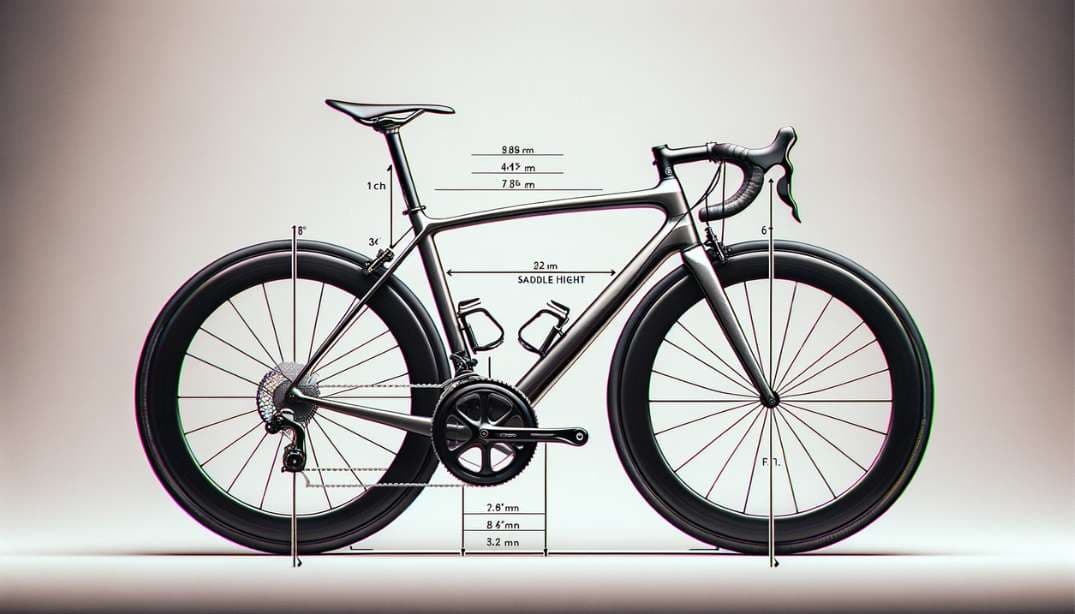
| Saddle height | Inseam × 0.883 | BB center to saddle top, along seat tube | Saddle Height Analyzer |
| Knee angle | 140–150° | At bottom of pedal stroke, foot flat | Saddle Height Analyzer |
| KOPS offset | -5 to +5 mm | Plumb line from knee cap at 3 o'clock crank | KOPS Analyzer |
| Back/torso angle | 40–50° from horizontal | Angle of torso relative to ground, hands on hoods | Cockpit Analyzer |
| Arm angle | 85–95° at elbow | Elbow bend while riding on hoods | Cockpit Analyzer |
| Hip angle | 45–55° | Angle at hip joint at top of pedal stroke | Full Fit Analysis |
| Ankle angle | 95–110° | Ankle dorsiflexion at bottom of stroke | Full Fit Analysis |
| Handlebar width | 38–44 cm | Match AC (shoulder) joint width | — |
| Stem length | 80–120 mm | Affects reach and handling | — |
| Crank length | 165–175 mm | Standard 170 mm, adjust for leg length | — |
| Saddle setback | 4–7 cm behind BB | Horizontal distance from BB to saddle nose | KOPS Analyzer |
Saddle Height: The Starting Point
Saddle height is the single most impactful measurement. Get it wrong and everything downstream — knee tracking, hip stability, power output — suffers.
The LeMond Formula
The most widely used starting point is Greg LeMond's formula:
Saddle height = Inseam × 0.883
This gives you the distance from the center of the bottom bracket to the top of the saddle, measured along the seat tube. For example, if your inseam is 84 cm, your saddle height should be approximately 74.2 cm.
A more conservative alternative, useful for riders new to fitting or those with limited flexibility:
Saddle height = Inseam × 1.09 (measured from pedal surface at 6 o'clock to saddle top)
How to Measure Your Inseam
- Stand barefoot against a wall.
- Place a hardcover book between your legs, spine up, pressed firmly against your crotch.
- Mark where the top of the book meets the wall.
- Measure from the floor to the mark.
Take three measurements and average them. Even a few millimeters matter at this stage.
Validating with Knee Angle
The formula gets you close, but the real test is your knee angle at the bottom of the pedal stroke. For road cycling, target 140–150° (where 180° would be a fully straight leg).
- Below 140°: saddle too low — wasted energy, increased knee stress
- Above 150°: saddle too high — rocking hips, hamstring strain, loss of power at the top of the stroke
Our Saddle Height Analyzer measures this angle from a single photo so you can verify without a goniometer.
For a detailed walkthrough of adjusting saddle height, see How to Adjust Saddle Height.
Saddle Fore/Aft: KOPS Positioning
Once saddle height is set, adjust the fore/aft position. This controls where your knee tracks relative to the pedal, which affects both power transfer and comfort.
The KOPS Method
With cranks at the 3 o'clock position (forward foot level), drop a plumb line from the front of your kneecap. On a road bike, this line should fall within -5 to +5 mm of the pedal spindle.
- Negative values (knee behind spindle): slightly more power-oriented, common for climbers
- Positive values (knee ahead of spindle): more quad-dominant, sometimes preferred for time trialing
Saddle Setback
A related measurement is saddle setback — the horizontal distance from the bottom bracket center to the tip of the saddle. For road bikes, this typically falls between 4–7 cm. Setback is determined by your seat tube angle and saddle rail position combined.
Use our KOPS Analyzer to check your knee position from a photo.
Back and Torso Angle
Your back angle — the angle of your torso relative to the horizontal — defines how aggressive or upright your position is. For road cycling, the target is 40–50° from horizontal.
- 40°: aggressive, race-ready position with good aerodynamics
- 50°: more relaxed, suitable for endurance riding or riders developing flexibility
This angle is primarily controlled by your handlebar height relative to saddle height (stack) and your reach (horizontal distance from saddle to bars). Spacers under the stem, stem angle, and stem length all influence it.
If your back angle is outside range, do not force it by simply slamming the stem. Work on hip flexibility and core strength gradually.
Arm Angle
The angle at your elbow while riding on the hoods should be 85–95°. This provides:
- Enough bend to absorb road vibration
- A natural, relaxed shoulder position
- Quick access to brake levers
Arms locked straight (angle approaching 180°) transmit every bump to your shoulders and neck. Arms too bent (below 80°) usually indicate the reach is too short.
The Cockpit Analyzer evaluates both your back angle and arm angle together, since they are closely linked.
Hip Angle
The hip angle — measured at the hip joint between your torso and thigh at the top of the pedal stroke (12 o'clock) — should be 45–55° for road riding.
A hip angle that is too closed (below 45°) restricts breathing and can cause hip flexor impingement on longer rides. This is a common issue when the saddle is too high, too far forward, or the handlebars are too low relative to the saddle.
Ankle Angle
The ankle angle at the bottom of the pedal stroke should be 95–110°. This represents a slight plantar flexion — toes pointing slightly down.
- Below 95°: excessive toe-pointing (ankling), often a sign of saddle too high
- Above 110°: heel dropping excessively, which can reduce power transfer
Most riders naturally fall in range once saddle height is correct, but it is worth checking, especially if you have ankle mobility limitations.
Handlebar Width
Handlebar width should match the distance between your AC joints (the bony points on top of your shoulders). For most riders this falls between 38 and 44 cm, measured center-to-center.
- Too narrow: restricted breathing, twitchy handling
- Too wide: aerodynamic penalty, shoulder fatigue
A common mistake is defaulting to whatever width came on the bike. If you are between sizes, go narrower for racing, wider for comfort and stability.
For more guidance, read our guide on correct handlebar width.
Stem Length
Stem length typically ranges from 80 to 120 mm on road bikes and has a major impact on reach and handling characteristics.
- Shorter stems (80–90 mm): quicker steering, more upright position
- Longer stems (100–120 mm): more stretched out, more stable at speed
Stem length should be determined by your fit, not the other way around. If you need a stem shorter than 80 mm or longer than 120 mm, the frame size is likely wrong.
Crank Length
Crank length affects your effective leg extension and hip angle at the top of the stroke.
- 170 mm: the most common stock length
- 172.5 mm: standard on many 56 cm+ frames
- 165 mm: worth considering for riders under 170 cm tall, or those with hip flexibility issues
Shorter cranks open the hip angle at the top of the stroke, which can improve comfort and breathing. Longer cranks give a marginal leverage advantage but increase the range of motion your joints must accommodate.
The Order of Operations
Bike fitting is sequential. Changing one measurement shifts others, so follow this order:
- Saddle height — set with the LeMond formula, validate with knee angle
- Saddle fore/aft — adjust using KOPS, recheck saddle height after
- Handlebar height and reach — set back angle and arm angle via stem and spacers
- Fine-tune — hip angle, ankle angle, handlebar width
If you change saddle height after setting your cockpit, go back and recheck your back and arm angles. Everything is connected.
For a full walkthrough of a DIY approach, see our guide on doing a bike fit at home.
How BikeFittr Measures These Angles
You do not need a goniometer, plumb line, or a trip to a bike fitter to check most of these measurements. Our AI-powered tools use pose detection from a single photo to calculate your joint angles and compare them against the target ranges for your bike type.
Upload a side-view photo of yourself on the bike, and the tool identifies your key landmarks — ankle, knee, hip, shoulder, elbow, wrist — and calculates each angle automatically.
Try Our Free AI Bike Fitting Tools
Ready to check your measurements? Upload a photo and get your angles in seconds:
- Saddle Height Analyzer — Measures knee angle at the bottom of the stroke
- Saddle Position (KOPS) — Checks knee-over-pedal-spindle alignment
- Cockpit Analysis — Evaluates back angle and arm angle together
Reduce guesswork
Ready to check your own fit?
Use this essential road bike fit measurements guide as the background, then run a quick BikeFittr check so visitors have a clear next step instead of leaving after reading.