Balancing Comfort and Performance in Triathlon Bike Fitting
BikeFittr Team
AI-powered bike fitting experts helping cyclists achieve the perfect ride.
Reduce guesswork
Want the answer for your own bike?
Use this balancing comfort and performance in triathlon bike fitting guide as the background, then run a quick BikeFittr check so visitors have a clear next step instead of leaving after reading.
AI bike fit app
Upload one side-view photo and get posture, saddle height, reach, and knee-angle feedback.
Full fit analysis
Start the guided fitting flow when you want the complete setup check.
Angle chart
Compare your knee, hip, back, and arm angles against practical fit ranges.
Popular next steps: Full fit analysis · Angle chart
Key Takeaways
| Factor | Comfort Priority | Performance Priority | BikeFittr Target (Tri Bike) |
|---|---|---|---|
| Hip angle | Open (43-53°) | Closed (32-42°) | 35-45° (base) |
| Back angle | Upright (28-43°) | Aggressive (15-30°) | 20-35° (base) |
| Knee angle | 142-152° | 148-158° | 145-155° (base) |
| Arm angle | Relaxed (78-93°) | Extended (65-80°) | 70-85° (base) |
| Saddle position | Moderate forward | Aggressive forward | KOPS +10 to +25 |
| Aerobar pad width | Wider for stability | Narrower for aero | As narrow as sustainable |
These ranges come directly from BikeFittr's tri bike fitting model, which is based on Retul data and biomechanical research. The comfort and performance columns show what happens when you apply BikeFittr's riding preference modifiers (+8° for comfort, -3° to -5° for performance).
The Comfort-Performance Spectrum
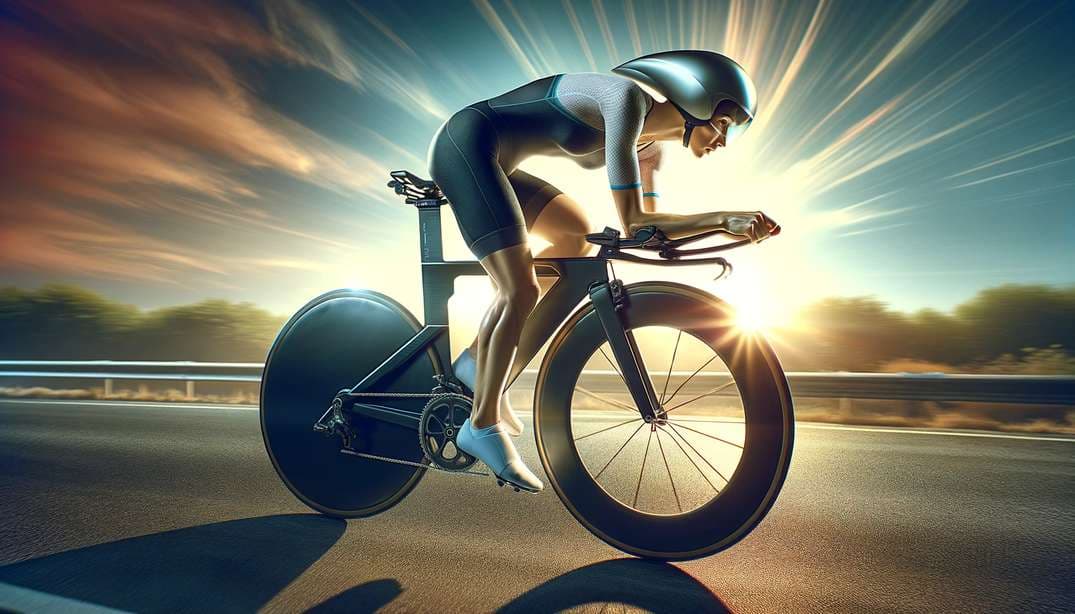
In triathlon bike fitting, comfort and performance exist on a spectrum rather than as opposing forces. The key insight: a position you cannot sustain is not actually faster.
Understanding where you fall on this spectrum helps you make informed decisions about your fit:
| Rider Type | Priority | Position Characteristics |
|---|---|---|
| Beginner | 80% comfort | More upright, wider contact points, hip angle 43-53° |
| Age-group athlete | 60% comfort | Moderate aggression, sustainable, hip angle 38-48° |
| Elite short-course | 40% comfort | Aggressive, highly trained, hip angle 32-40° |
| Elite long-course | 50% comfort | Fast but maintainable for 4-5 hours, hip angle 38-45° |
Measure your current hip angle with BikeFittr's cockpit analysis to see where you fall on the comfort-performance spectrum.
Why "More Aero" Isn't Always Faster
The Aerodynamic Gains Are Real — But They Have a Ceiling
Let's put real numbers on this. The difference between an upright road position (CdA around 0.35 m²) and a good aero position on a tri bike (CdA around 0.25 m²) is worth roughly 30-40 watts at race pace (around 35-40 km/h). That is enormous — it is the single biggest free speed gain available to any triathlete.
Every 1 cm of bar drop saves roughly 1-2 watts at 40 km/h, based on wind tunnel data. So yes, getting lower matters.
But here is the problem: aerodynamic gains follow a curve of diminishing returns, while the physiological costs of an overly aggressive position escalate fast.
The Fatigue Factor
An aggressive position provides aerodynamic benefits, but those benefits collapse when:
- You cannot maintain the position for the entire bike leg (sitting up for even 10% of the ride wipes out most aero gains)
- Hip flexor fatigue compromises your run
- Core muscles fail, causing position breakdown in the final third
- Breathing becomes restricted because your diaphragm is compressed
The Power Output Trade-off
In practice, when athletes close their hip angle below 40°, most see a 5-15% power drop from restricted breathing and hip impingement. Retul data from thousands of fits confirms this pattern. The causes are straightforward:
- Compromised breathing mechanics — a closed hip angle compresses the diaphragm, reducing tidal volume
- Hip angle restricting glute and hamstring engagement at the top of the pedal stroke
- Core instability reducing pedaling efficiency as fatigued muscles stop supporting the pelvis
But below 40° hip angle, most riders lose more power from restricted breathing than they gain from aerodynamics. This is the critical threshold where the trade-off flips.
A Real-World Example
In my Ironman 70.3 prep, I tested two positions: a 38° hip angle (aggressive) and a 48° hip angle (moderate). On the bike, the aggressive position was 2 minutes faster over 90 km. But in the brick run, I was 5 minutes slower. The moderate position won by 3 minutes overall — and I actually enjoyed the run.
This is not unusual. The athletes who consistently post fast combined bike-run splits are rarely the ones in the most aggressive positions. They are the ones who found the position that lets them ride fast and still run.
The net result: A slightly less aero position that you can sustain — and that preserves your legs for the run — almost always produces faster overall race times.
Key Fit Elements for Balance
Hip Angle: The Critical Measurement
Your hip angle (the angle at your hip joint in the aero position) is the primary determinant of comfort vs. performance. BikeFittr's tri bike model targets 35-45° as the base range. Here is how that breaks down by distance:
| Hip Angle | CdA Impact | Power Impact | Best For |
|---|---|---|---|
| 32-38° | Excellent aero (CdA ~0.24-0.26) | 5-15% power loss risk | Elite short-course only, requires exceptional flexibility |
| 38-45° | Very good aero (CdA ~0.25-0.28) | Minimal power loss | Trained athletes, Olympic and 70.3 distance |
| 45-53° | Good aero (CdA ~0.28-0.31) | No power compromise | Most age-groupers, Ironman distance |
| 53-60° | Moderate aero (CdA ~0.30-0.34) | Full power, easy breathing | Beginners, ultra-distance, injury recovery |
For comparison, a road bike targets a hip angle of 45-55°. So even a "comfortable" tri position (with BikeFittr's comfort modifier pushing the range to 43-53°) is still more aggressive than a standard road bike fit.
Knee Angle: The Foundation
Before worrying about aerodynamics, your knee angle must be right. BikeFittr targets 145-155° for tri bikes (compared to 140-150° for road bikes). The slightly more extended tri position compensates for the forward hip rotation in aero position and opens up the hip angle.
Verify your knee angle is in the 145-155° tri range with BikeFittr's saddle height tool. Getting saddle height wrong undermines everything else.
Back Angle: Your Aero Signature
BikeFittr's tri bike model targets a back angle of 20-35° from horizontal. This is where most of your aerodynamic gains come from:
- 20-25°: Very aggressive. Requires excellent core strength, hip flexibility, and regular training in the position. Potential CdA of 0.23-0.25.
- 25-30°: The sweet spot for most competitive age-groupers. Good aero with sustainable effort.
- 30-35°: Moderate aggression. Appropriate for longer distances or athletes building toward a more aggressive position.
With BikeFittr's performance modifier applied, the back angle target shifts to 15-30°. With the comfort modifier, it opens to 28-43°. Choose the modifier that matches your race distance and experience.
Saddle Selection and Position
The saddle affects both comfort and power transfer:
For comfort emphasis:
- Moderate padding
- Wide enough for sit bones
- Cutout for pressure relief
- Slightly less forward position (closer to KOPS +10)
For performance emphasis:
- Minimal padding for stability and consistent positioning
- Narrow for freedom of movement
- Forward position (KOPS +20 to +25) for hip opening
- Flat profile for position changes
Aerobar Setup
Your aerobar configuration significantly impacts both aerodynamics and comfort:
| Adjustment | Comfort Setting | Performance Setting | Aero Impact |
|---|---|---|---|
| Pad width | Shoulder width or wider | Narrower than shoulders | 2-5 watts at 40 km/h |
| Stack height | Higher, less forward lean | Lower, more aggressive | 1-2 watts per cm |
| Extension length | Shorter for less reach | Longer for aero tuck | Minimal if head position changes |
| Pad angle | Slight upward tilt | Flat or slight down | Negligible |
Distance-Specific Recommendations
Sprint Triathlon (750m / 20km / 5km)
With only 30-45 minutes on the bike, you can afford more aggression:
- Prioritize aerodynamics — the run is short enough to recover
- Hip angle 35-42° acceptable for trained athletes
- Apply BikeFittr's performance modifier: hip 32-42°, back 15-30°
- Focus on peak power output at threshold
- The aero gains at sprint-distance speeds (35-42 km/h) are significant
Olympic Distance (1.5km / 40km / 10km)
The inflection point for many athletes:
- 60-90 minutes of cycling — position must be sustainable but can be aggressive
- Hip angle 35-45° recommended (BikeFittr's base tri range)
- The 10 km run is long enough that bike position matters for run quality
- Moderate aerodynamic priority with an eye on transition freshness
Half Ironman (70.3)
At 2.5-3.5 hours on the bike, comfort becomes more critical:
- Sustainable power trumps peak aerodynamics
- Hip angle 40-48° for most athletes
- Apply BikeFittr's endurance modifier: hip 40-50°, back 25-40°
- Saddle comfort is essential — numbness at hour 2 destroys power at hour 3
- Stack height can be slightly higher; losing 2-3 watts in aero is worth gaining 10 watts from better breathing
Full Ironman
With 4.5-7+ hours of cycling, the run is everything:
- Position must be maintainable for the entire ride without sitting up
- Hip angle 43-53° recommended (BikeFittr's comfort modifier range)
- Fresh legs for the marathon are more important than shaving 30 seconds on the bike
- Consider nutrition accessibility — can you reach your bottles and eat without leaving aero?
- Back angle 28-40° is typical for age-group Ironman athletes
The Run Impact
Your bike position directly affects your run performance. This is what separates triathlon fitting from pure cycling fitting:
| Bike Position Factor | Run Impact | Why It Happens |
|---|---|---|
| Very closed hip angle (<38°) | Tight hip flexors, shortened stride | Hip flexors locked short for hours cannot extend for running |
| Excessive saddle forward (KOPS >25) | Fatigued quads, heavy legs | Quad-dominant pedaling burns your run muscles |
| Poor saddle choice | Numbness, circulation issues | Pudendal nerve compression affects gait |
| Too aggressive overall | "Jelly legs" transition | Total neuromuscular fatigue from fighting the position |
| Back angle too low (<20°) | Neck and shoulder pain on the run | Cervical spine stress from looking up for hours |
For run-focused considerations, see our guide on transition efficiency.
Finding Your Personal Balance
Step 1: Measure Your Current Position
Before changing anything, know where you start. Use BikeFittr's cockpit analysis to measure your current hip angle and back angle, and BikeFittr's saddle height tool to check your knee angle.
Record these baseline numbers:
- Hip angle: ___ ° (tri target: 35-45°)
- Back angle: ___ ° (tri target: 20-35°)
- Knee angle: ___ ° (tri target: 145-155°)
- Arm angle: ___ ° (tri target: 70-85°)
Then ask yourself:
- Can you hold the aero position for your target bike duration without sitting up?
- Do you have energy for the run after a hard bike?
- Are you experiencing any numbness or pain?
- Is your breathing restricted in aero?
Step 2: Identify Problem Areas
Common issues and their comfort/performance implications:
| Symptom | Likely Cause | Angle to Check | Solution Direction |
|---|---|---|---|
| Neck pain | Bars too low | Back angle <20° | Increase stack (comfort) |
| Hip pain in aero | Hip angle too closed | Hip angle <35° | Open hip angle, raise bars |
| Numb hands | Too much weight forward | Arm angle, reach | Shorten reach, raise pads |
| Lower back pain | Hip closed + weak core | Hip angle <38° | Open hip, strengthen core |
| Slow bike split | Position too upright | Back angle >40° | Lower bars gradually (performance) |
| Poor run off bike | Bike position too aggressive | Hip angle <38° | Open hip angle by 3-5° |
| Breathing restricted | Diaphragm compressed | Hip angle <40° | Open hip angle, raise bars |
| Cannot hold position | Overall too aggressive | Multiple angles | Apply comfort modifier |
Step 3: Make Incremental Changes
Adjust in small increments and give your body time to adapt:
- Saddle height: 3-5 mm changes (affects knee angle by roughly 2-3°)
- Stack height: 5-10 mm changes (affects back angle by roughly 1-2°)
- Saddle fore/aft: 5 mm changes (affects hip angle and KOPS)
- Aerobar pad position: 5 mm reach changes
- Allow 2-3 rides of at least 60 minutes to adapt before further changes
- Never change more than one variable at a time
Step 4: Test Under Race Conditions
Validate your fit in training that mimics race intensity. Position data from easy rides is misleading — you need to know how the position holds up when you are pushing threshold power:
- Brick workouts (bike-to-run): The single best test. Can you run well immediately off the bike?
- Time trial efforts at race pace: Can you hold aero for the full duration?
- Long rides at target duration: Does your position break down in the last third?
- Hot weather sessions: Heat amplifies fatigue and position problems
- Back-to-back days: Accumulated fatigue reveals fit issues that single sessions hide
The BikeFittr Approach to Tri Fitting
BikeFittr's tri bike fitting model uses these base targets:
| Measurement | Target Range | What It Controls |
|---|---|---|
| Knee angle | 145-155° | Saddle height, power transfer |
| Back angle | 20-35° | Aerodynamics, core load |
| Hip angle | 35-45° | Breathing, hip flexor load, run impact |
| Arm angle | 70-85° | Reach, weight distribution |
| KOPS offset | +10 to +25 | Saddle fore/aft, muscle recruitment |
You can then apply a riding preference modifier based on your race distance and goals:
| Modifier | Hip Angle Shift | Back Angle Shift | Best For |
|---|---|---|---|
| Performance | -3° (→ 32-42°) | -5° (→ 15-30°) | Sprint, Olympic |
| Balanced | 0° (→ 35-45°) | 0° (→ 20-35°) | Olympic, 70.3 |
| Endurance | +5° (→ 40-50°) | +5° (→ 25-40°) | 70.3, Ironman |
| Comfort | +8° (→ 43-53°) | +8° (→ 28-43°) | Ironman, beginners |
| Aerodynamic | -5° (→ 30-40°) | -10° (→ 10-25°) | TT specialists only |
For comparison, a road bike targets: knee 140-150°, back 40-50°, hip 45-55°. The tri bike is more aggressive across every dimension, which is why getting it right matters more.
Conclusion
The best triathlon bike fit is not the most aggressive one — it is the one that maximizes your combined bike-plus-run speed over your specific race distance. A position that saves you 2 minutes on the bike but costs you 5 minutes on the run is a bad trade.
Start with BikeFittr's base tri targets (hip 35-45°, back 20-35°, knee 145-155°) and apply the modifier that matches your distance. Measure your current angles with BikeFittr's fitting tools, compare them to the targets, and make incremental changes. The athletes who find their optimal balance — rather than simply copying pro positions — consistently achieve better race results.
Your optimal balance point is individual. It depends on your hip flexibility, core strength, race distance, and how much you value the run. But with real angle data instead of guesswork, you can find it faster.
Try Our Free AI Bike Fitting Tools
Ready to find your balance of comfort and performance? Our AI-powered tools analyze your position from a photo and compare it against the tri bike targets discussed in this article:
- Saddle Height Analyzer — Check your knee angle against the 145-155° tri target
- Saddle Position (KOPS) — Verify your fore/aft position is in the +10 to +25 range
- Cockpit Analysis — Measure your hip angle, back angle, and arm angle in one shot
Reduce guesswork
Ready to check your own fit?
Use this balancing comfort and performance in triathlon bike fitting guide as the background, then run a quick BikeFittr check so visitors have a clear next step instead of leaving after reading.