
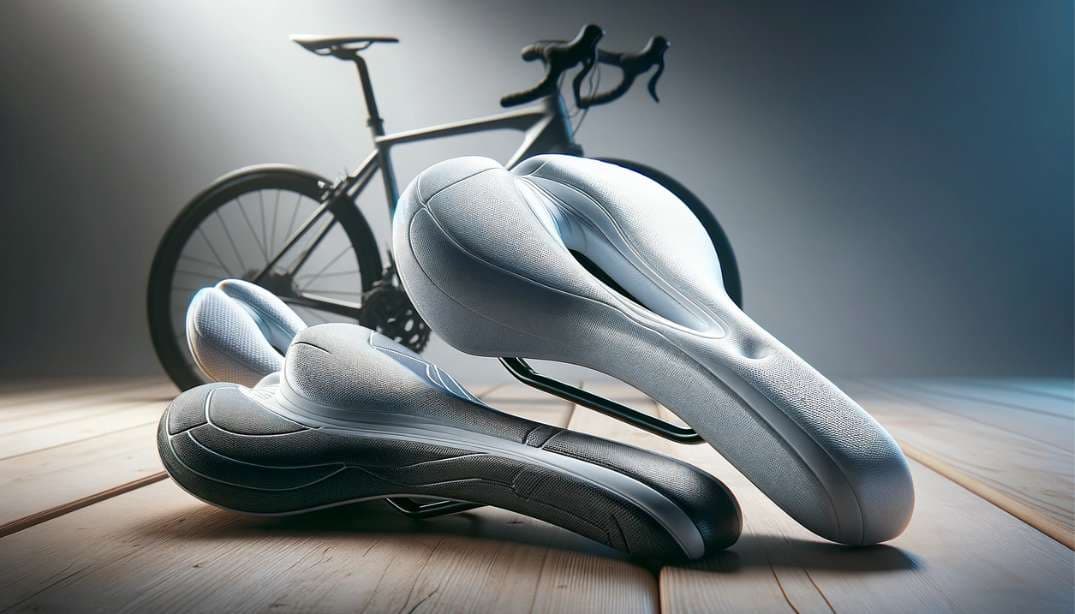
Choosing the Right Saddle for Road Bike Fit
Triathlete and founder of BikeFittr
Reduce guesswork
Want the answer for your own bike?
Use this choosing the right saddle for road bike fit guide as the background, then run a quick BikeFittr check so visitors have a clear next step instead of leaving after reading.
AI bike fit app
Upload one side-view photo and get posture, saddle height, reach, and knee-angle feedback.
Full fit analysis
Start the guided fitting flow when you want the complete setup check.
Angle chart
Compare your knee, hip, back, and arm angles against practical fit ranges.
Popular next steps: Full fit analysis · Angle chart
How to Choose the Right Road Bike Saddle
The saddle is one of three contact points on your bike, and it carries roughly 60% of your body weight while riding. A wrong saddle causes numbness, chafing, and lower back pain. A correct one disappears under you. The difference comes down to measurable factors: sit bone width, riding position, and saddle shape. Here is how to get it right without months of trial and error.
"I went through 4 saddles before finding the right one -- and the answer turned out to be measuring my sit bones first. Once I knew my width (112mm), choosing a 143mm saddle with a center channel was obvious. Save yourself the trial-and-error and measure first." -- Heiko, BikeFittr founder
Step 1: Measure Your Sit Bone Width
Your sit bone (ischial tuberosity) width is the single most important measurement for saddle selection. Every saddle manufacturer bases their sizing on it, yet most cyclists skip this step entirely.
DIY method -- corrugated cardboard:
- Place a piece of corrugated cardboard on a hard, flat surface like a wooden stool or bench.
- Sit down firmly with your feet flat on the floor. Stay seated for 30 seconds.
- Stand up and look at the cardboard. You will see two oval depressions where your sit bones pressed in.
- Measure the distance between the centers of the two deepest impressions in millimeters.
- Repeat 2-3 times and average the results.
Bike shop method -- gel pad:
Many shops (especially those carrying Specialized or Bontrager) have a gel pad or digital pressure mapping system. You sit on the pad for 30 seconds, and it records precise imprints. This is more accurate than cardboard and usually free with a saddle purchase.
Typical ranges: Most men measure between 100-130mm, most women between 110-145mm. These are averages -- your anatomy is individual, so always measure.
Step 2: Match Sit Bone Width to Saddle Width
Your saddle should be approximately 20-30mm wider than your sit bone width. This ensures your sit bones rest fully on the saddle's supportive platform rather than hanging off the edges or sitting too far inward.
| Sit Bone Width | Recommended Saddle Width | Example Models |
|---|---|---|
| < 100mm | 130mm | Specialized Power 130, Fizik Arione |
| 100 - 115mm | 143mm | Specialized Romin 143, Selle Italia SLR |
| 115 - 130mm | 155mm | Specialized Power 155, Selle Italia Diva |
| > 130mm | 168mm | Specialized Power 168, Terry Butterfly |
If you fall between sizes, go wider rather than narrower. A slightly wider saddle still supports your sit bones. A too-narrow saddle forces soft tissue to bear weight it should not.
Step 3: Pick Saddle Shape by Riding Position
Your back angle on the bike changes how your pelvis contacts the saddle. An aggressive aero position rotates your pelvis forward, shifting weight onto a narrower contact area. An upright position keeps your sit bones fully engaged.
| Position | Back Angle | Best Saddle Shape | Why |
|---|---|---|---|
| Aggressive | < 45° | Flat, narrow, minimal padding | Pelvic rotation forward means sit bones are less loaded; support shifts to the pubic rami |
| Moderate | 45 - 55° | Medium width, slight curve | Balanced weight distribution between sit bones and soft tissue |
| Upright | > 55° | Wider, more padding, shorter nose | Full sit bone contact with maximum surface area needed |
This is why a triathlete on aerobars needs a completely different saddle than a touring cyclist -- even if their sit bone width is identical. For guidance on optimizing your riding position, use our saddle offset (KOPS) tool or check your saddle angle.
Key Features to Look For
Cutout or center channel: A relief channel or full cutout through the saddle center reduces pressure on the perineum and pudendal nerve. If you experience any numbness or tingling, a cutout saddle should be your first change. Most modern performance saddles (Specialized Power, Fizik Argo, PRO Stealth) now include this feature as standard.
Flat vs. curved profile: Flat saddles allow you to move freely forward and back, ideal for riders who shift position frequently. Curved saddles lock you into one position, providing stability for consistent efforts like time trials.
Rail material: Carbon rails save 30-50g and dampen vibration slightly. Titanium rails offer a good weight-to-durability ratio. Chromoly (steel) rails are the most affordable and durable. For most riders, rail material matters far less than width and shape.
Padding thickness: More padding is not better. Thick padding compresses unevenly, creating pressure points over long rides. Firm saddles with minimal padding distribute load across your sit bones more effectively. Race saddles use 3-6mm of foam, while endurance saddles use 8-12mm.
Price Ranges and What You Get
| Category | Price Range | What to Expect |
|---|---|---|
| Budget | $30 - $60 | Chromoly rails, basic foam padding, good for casual and commuting |
| Mid-range | $60 - $150 | Ti or hollow rails, better foam density, cutout options, suitable for regular training |
| Premium | $150 - $300+ | Carbon rails or carbon shell, optimized shapes, pressure-mapped designs, race-grade |
A $70 saddle in the right width will always outperform a $250 saddle in the wrong width. Spend money on getting the fit right first, then upgrade materials if you want to save weight.
Women-Specific Saddle Considerations
Women generally have wider sit bones and shorter pelvic geometry. Women-specific saddles typically feature:
- Wider platforms (143-168mm is common)
- Shorter noses to reduce soft tissue pressure
- Wider and more pronounced relief channels
- Softer padding density for lower body weight
However, saddle choice should always be based on your individual sit bone measurement and riding position, not gender alone. Some women ride narrow saddles comfortably; some men need wide ones. For a deeper guide, see our article on road bike fit for women.
Warning Signs Your Saddle Is Wrong
Do not ignore pain or discomfort -- these are specific signals:
- Numbness after 30+ minutes: Your saddle is too narrow, too flat, or lacks a center channel. Soft tissue is bearing weight meant for your sit bones.
- Chafing on inner thighs: The saddle is too wide for your riding position, or the nose angle is incorrect. Check your saddle angle setting.
- Lower back pain: Often caused by a saddle that is too high or too far back, forcing your pelvis to rock. Verify your saddle height and saddle offset.
- Soft tissue pain or pressure sores: You need a cutout or channel saddle, or a different saddle shape altogether. This is the most common issue and the easiest to solve.
- Sliding forward constantly: The saddle nose is tilted down too far, or the saddle is too far back relative to your bottom bracket.
If you experience any of these consistently, address them before they become chronic. Most saddle problems are solved by getting the width right and adjusting the angle to level or very slightly nose-down (0 to -2 degrees).
Conclusion
Saddle selection is not guesswork. Measure your sit bones, match them to the right width, pick a shape that suits your riding position, and verify with a proper fit check. The right saddle eliminates pain, improves power transfer, and lets you focus on the ride instead of counting down the kilometers until you can stand up.
Try Our Free AI Bike Fitting Tools
Selected your saddle? Now verify your position with our AI-powered tools:
- Saddle Height Analyzer - Get your optimal knee angle
- Saddle Position (KOPS) - Check fore/aft positioning
- Cockpit Analysis - Optimize reach and drop
Reduce guesswork
Ready to check your own fit?
Use this choosing the right saddle for road bike fit guide as the background, then run a quick BikeFittr check so visitors have a clear next step instead of leaving after reading.