
How to Adjust Saddle Height: The Complete Guide for Cyclists
Triathlete and founder of BikeFittr
Reduce guesswork
Want the answer for your own bike?
Use this how to adjust saddle height: the complete guide for cyclists guide as the background, then run a quick BikeFittr check so visitors have a clear next step instead of leaving after reading.
Check saddle height now
Measure your knee angle from a riding photo before changing the seatpost.
Run full AI bike fit
Validate saddle height together with reach, hip angle, and overall posture.
Photo setup checklist
Make sure camera height, lighting, and riding position are accurate.
Popular next steps: Run full AI bike fit · Photo setup checklist
Getting your saddle height right is the single most important bike fit adjustment you can make. It affects your power output, comfort, and risk of injury. Yet many cyclists ride for years with a saddle that's too high or too low.
In this guide, you'll learn exactly how to find your optimal saddle height using proven methods—and how to use BikeFittr's free AI tool to verify your setup.
Why Saddle Height Matters
Your saddle height determines how much your knee bends at the bottom of each pedal stroke. This angle (called the knee extension angle) has a massive impact on:
- Power output: Too high or low reduces your ability to generate force
- Efficiency: The wrong height wastes energy with every pedal stroke
- Knee health: Incorrect height is the #1 cause of cycling knee injuries
- Comfort: Hip rocking, numbness, and lower back pain often trace back to saddle height
The Ideal Knee Angle
When your pedal is at the 6 o'clock position (bottom of the stroke), your knee should have a slight bend. Sports scientists measure this as the angle between your thigh and shin:
| Bike Type | Ideal Knee Angle |
|---|---|
| Road Bike | 140-150° |
| Mountain Bike | 135-145° |
| Triathlon/TT | 145-155° |
| City/Commuter | 130-140° |
| Trekking | 135-145° |
A knee angle of 145° means your leg is nearly straight but not locked out.
Method 1: The Heel-to-Pedal Method
This is the quickest way to get a baseline saddle height:
Step-by-Step:
- Set up your bike on a trainer or against a wall
- Rotate the pedals so one crank is at the 6 o'clock position (straight down)
- Sit on the saddle in your normal riding position
- Place your heel on the pedal (not the ball of your foot)
- Check your leg: It should be completely straight with no bend
When you move your foot to the normal pedaling position (ball of foot over the spindle), you'll have the correct slight bend in your knee.
Why This Works
The difference between your heel and the ball of your foot is roughly 25-30mm. This creates the slight knee bend you need when pedaling normally.
Method 2: The LeMond Formula
Three-time Tour de France winner Greg LeMond popularized this mathematical approach:
Saddle height = Inseam × 0.883
To measure your inseam:
- Stand barefoot against a wall
- Place a book between your legs, spine up, pressed firmly against your crotch
- Measure from the floor to the top of the book
- Multiply by 0.883
This gives your saddle height measured from the center of the bottom bracket to the top of the saddle.
Limitations
The LeMond formula is a starting point, not the final answer. It doesn't account for:
- Crank length differences
- Pedal/cleat stack height
- Individual flexibility
- Riding style preferences
Method 3: AI-Powered Analysis
The most accurate method uses visual analysis of your actual position on the bike. BikeFittr's saddle height tool uses AI to:
- Detect your body position automatically
- Measure your actual knee angle at the bottom of the stroke
- Compare it to optimal ranges for your bike type
- Calculate exactly how many millimeters to raise or lower your saddle
Try the free saddle height analyzer →
Signs Your Saddle Is Too High
Watch for these symptoms:
- Hip rocking: Your hips sway side to side when pedaling
- Reaching for the pedals: You feel like you're stretching at the bottom
- Achilles pain: Strain on the tendon from toe-pointing
- Lower back pain: From excessive pelvic tilt
- Knee pain behind the kneecap: From overextension
- Numbness in feet or groin: From excessive pressure
Signs Your Saddle Is Too Low
These indicate your saddle needs to go up:
- Front knee pain: From excessive quad loading
- Knee pain at the front/top of the kneecap: Classic "too low" symptom
- Quick fatigue: Your muscles work harder when compressed
- Bouncing at high cadence: You can't spin smoothly
- Feeling cramped: Like you can't extend your legs properly
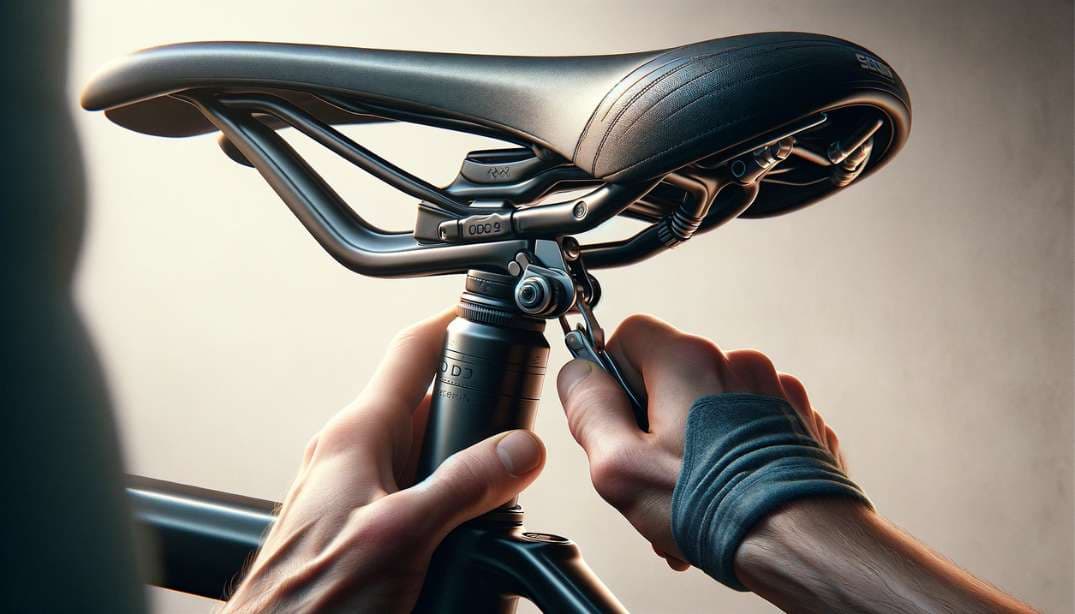
How to Make the Adjustment
You'll need:
- A 4mm, 5mm, or 6mm Allen key (depending on your seatpost clamp)
- A tape measure
- A marker or tape
Steps:
- Mark your current position with tape or a marker on the seatpost
- Loosen the clamp bolt (usually 1-2 turns is enough)
- Adjust the height in small increments (5mm at a time)
- Tighten the bolt to the specified torque (check your seatpost)
- Test ride and note how it feels
- Repeat until it feels right
Important Tips:
- Never exceed the minimum insertion line on your seatpost
- Make small adjustments—5mm makes a noticeable difference
- Give yourself time to adapt (a few rides) before making more changes
- If you've been riding "wrong" for years, the correct height may feel strange at first
Crank Length Matters Too
Your crank length affects the effective saddle height. Shorter cranks (165-170mm) effectively lower your saddle, while longer cranks (175-180mm) raise it.
If you're considering changing crank length, use our crank length calculator to find your optimal size.
When to Get a Professional Fit
While DIY methods work well for most cyclists, consider a professional fitting if:
- You have persistent pain despite adjustments
- You have a significant leg length discrepancy
- You're recovering from injury
- You're a competitive cyclist seeking marginal gains
- Multiple adjustments haven't solved your issues
Quick Reference Checklist
✅ Crank at 6 o'clock position for measurement ✅ Heel on pedal = straight leg ✅ Ball of foot on pedal = 25-35° knee bend ✅ No hip rocking when pedaling ✅ Comfortable for 30+ minutes ✅ No knee pain during or after rides
Next Steps
- Measure your current setup using the heel method
- Analyze with AI using BikeFittr's saddle height tool
- Make small adjustments (5mm at a time)
- Test ride and reassess
- Continue to saddle position (KOPS) for complete lower body fit
Frequently Asked Questions
How do I know if my saddle is too high?
The most common signs your saddle is too high include: hip rocking from side to side when pedaling, reaching or stretching at the bottom of the pedal stroke, pain in the back of the knee, lower back pain, and numbness in the feet or groin area. If you experience any of these symptoms, try lowering your saddle by 5mm and test ride.
How do I know if my saddle is too low?
Signs your saddle is too low include: pain at the front of the knee (especially above the kneecap), quick fatigue in your quadriceps, bouncing in the saddle at high cadence, and feeling cramped or unable to extend your legs properly. Try raising your saddle by 5mm and reassess.
What is the correct knee angle for cycling?
For road bikes, the ideal knee angle at the bottom of the pedal stroke is 140-150°. Mountain bikes work best at 135-145°, triathlon bikes at 145-155°, and city bikes at 130-140°. Your knee should have a slight bend—never fully locked out.
Can I use a formula to calculate saddle height?
Yes, the LeMond formula (inseam × 0.883) provides a starting point. However, formulas don't account for individual factors like flexibility, crank length, and cleat stack height. Use formulas as a baseline, then fine-tune based on feel or use AI analysis for more precision.
How often should I check my saddle height?
Check your saddle height whenever you change shoes, pedals, or cleats, as these affect your effective leg length. Also reassess after any bike service, if you develop new pain, or at the start of each season. Most cyclists benefit from verifying their position 2-3 times per year.
Does crank length affect saddle height?
Yes, crank length directly impacts your effective saddle height. Longer cranks (175mm+) effectively raise your saddle position, while shorter cranks (165-170mm) lower it. If you change crank lengths, you'll likely need to adjust your saddle height to maintain the same knee angle.
Ready to check your saddle height? Try BikeFittr's free AI saddle height analyzer and get precise recommendations in minutes.
Reduce guesswork
Ready to check your own fit?
Use this how to adjust saddle height: the complete guide for cyclists guide as the background, then run a quick BikeFittr check so visitors have a clear next step instead of leaving after reading.